Friday, August 1, 2008
6 Ways to improve your foot speed!
Discover the secrets world class sprinters have known for years - the key to foot speed is 'dorsi and planter flexion'. These 6 drills will definitely improve your foot speed!
It is a well-known fact that the dorsi- and plantar flexion action of the foot, is a characteristic of sprinters. To improve on the working capacity of the tibialis anterior, extensor digitorum longus, peroneus longus, soleus and gastrocnemius that does most of this work they have to be strengthened and have a greater capacity to apply force faster.
The dorsi flexion action is not merely a lift of the toes, but rather a lifting of the front part of the foot. The plantar flexion action is not just a downward movement of the foot, it has to be done in such a manner that it applies maximum force against the ground in the shortest possible time.
Basically we are trying to to reduce the athletes ground contact time and thus help improve on speed.
Ways To Improve Your Speed:
1. Seated foot up
3 - 4 sets of 30 lifts per foot at varied pace.
2. Standing foot lifts
3 - 4 sets of 30 lifts per foot. As balance plays role here, it can also help improve your stability.
3. Walking with foot lifts. (Small steps)
Everytime you lift your foot up moving forward, make sure you lift your foot up and land on the front part of your foot. Throughout this exercise you stay on your toes. Walk distances of 15 - 20m. 3 - 4 reps.
4. Jogging with foot lifts. (Small steps to long steps)
Do this with stiff knees and "pulling" with the hamstrings and calf muscles to move forward. Dorsi flex the foot everytime it lifts of the ground to take another step. Do 3 - 4 reps over distances ranging from 15 - 35m.
5. Skipping.
This is a very common training method that will enhance the dorsi- and platar flexion. Important to not that the foot lifts up every tiem it leaves the ground. Start with 30 touch downs (Td) and work it up to 100. It can also be done against time.
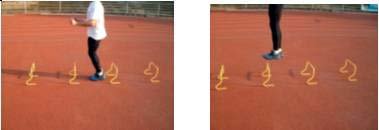
6. Short jumps (Static or dynamic forward movement, mini hurdles)
Do 3 - 4 sets of 1020 jumps and lift the feet after every touchdown. Dynamic jumps - work from 15 - 35m with the same action. IMPORTANT: Try not to bend the knees too much as this will only slow the action down.
The above exercises are just a few thoughts. There are many other coaches with great ideas. It is however important for sprinters to do this type of training at least twice per week in the general preparation phase and once per week during the specific preparation phase.

Body building for tennis
I've designed four separate routines that work different parts of the body. Each workout will help to increase strength, size and stamina and with in turn improve your tennis ability while helping put on mass. For each workout I have included a brief description of while training that part of the body helps to improve your performance on the tennis court.ExercisesA tennis player needs to become stronger, faster, and more agile, and to improve endurance. When I was designing this programme I studied the movements that occurred on the tennis court and selected conditioning exercises that simulated those activities. I also selected exercises that would prevent injuries by correcting muscle imbalances, particularly in the shoulder area. For this part I got a bit of help from the fitness trainer at my club and my tennis coach as I found it difficult to find pacific exercises for this purpose. This programme developed involves an amazing number of muscle groups, each of which makes a specific contribution to performance of the required skills. When I found out all the exercises which would be beneficial I knew I could not do the whole programme in one workout as I would be overtraining my partner, so I would have to do them on separate days which is why I decided on a four day split so my workouts would take around 45 minutes to 1 hour to complete.In tennis you know the first thing you have to do is get to the ball. Most of the exercises in the first workout develop the quick foot speed you need to get to every ball. By reducing foot contact time, you'll cover the court more quickly and efficiently.Workout 1- Foot Speed Depth jump with lateral movement Push-up with clap Hexagon drill Single leg push-off Side-to-side box shuffle Jump and reach Split squat jump Jump over barrier (side) 30-60-90 box drill Jump to box Lateral cone hopsWorkout 2- Lower Body (Legs)Tennis power starts at ground level and works its way up through your body. By the time you make contact with the ball, you've generated a lot of force along this chain. For this reason you need to develop strength in your lower extremities-your legs-so your push-off will be strong. From your serve to your low volleys to even the first step after a wide ball, your game relies on power in your legs. It has been found that Tim Henman has got his personal trainer to help him with his leg development for overall power. This shows how important the leg development is. The following exercises will strengthen these-
Back squat Calf raise (seated) Bench step-up Leg curl (facedown) Calf raise (machine) Leg press Cross-over lunge Side lunge Front lunge Walking lunge 45-Degree lunge
Workout 3- Trunk and AbsYou need a quick start on court, and these exercises will help develop one. They work to support the low back, helping in injury prevention. They also play an important role in maintaining range of motion and strength for serves and overheads. When I serve I bend my back quite far back which has caused me to work on my trunk development. The programme I used and found very effective included- Back extension Hip rotation Bicycle Knee pull-in Glute-ham raise Russian twist Hip press-up Side sit-up Hip roll Sit-up with legs raisedAbdominal MusclesCompleted Everything you do in tennis revolves around your abdominal muscles. Strengthening your abdominals, trunk, and upper extremities will improve your range of motion. These exercises include- Drop pass Pullover toss Kneeling side throwWorkout 4- Upper ExtremitiesYou can't play tennis if you can't hold on to your racket. As your opponents increase the power of their shots, you need to strengthen your grip to fight back. Wrist exercises will not only build strength, they'll also condition the muscles of the forearm to absorb the impact from ball contact. This will decrease your chances of injuries from overuse, such as tennis elbow. During a long match as with other body parts your wrists can hurt the most. This is due to the constant hitting of the ball and the impact that causes your wrists to take a lot of strain. This is why exercising your wrists are very important. The exercises include- Wrist flexion/extension Wrist ulnar/radial flexion Wrist pronation/supinationAll the twisting and turning you do in the course of a day on court puts your body through a rigorous workout. Shoulder exercises will help with your ground strokes and overheads while also preventing injuries. These exercises include-
Pec dec Seated row Prone fly Push press Dumbbell row Pullover and press Bench press Pullover Incline press (barbell) Front and back pulldown
There are four separate workouts in this programme. Each workout should last about 45 minutes- 1 hour and each workout should be done once a week. I have mentioned the different exercises you can do for each workout but did not specify which ones which enables you to change various exercises.
I recommend changing certain exercises every six to eight weeks to prevent your body from getting used to the set exercises. You should go with a 12-15 rep scheme as this will also help with your stamina when you are playing long matches.
I recommend doing three-four exercises and 3 sets per exercise. Remember like with all training concentrate on form rather than letting your ego get the best of you.
Flexibility for swimming!
Before you dive in and start counting laps, remember that just because swimming doesn't involve any impact on the joints, that doesn't mean joint flexibility is not important.
With summer in full swing and temperatures rising, many of us turn to the pool as a cool way to get some aerobic exercise without all the sweat. But before you dive in and start counting laps, remember that just because swimming doesn't involve any impact on the joints, that doesn't mean that joint flexibility isn't important.
In fact, swimming performance can be greatly improved if you train for the flexibility needed to smooth out your favorite stoke.
The best swimmers incorporate flexibility training into their regimen for two main reasons. First, as muscles are stretched, the individual fibers lengthen. A longer muscle fiber can create more force when it contracts. So flexibility training helps to increase the muscle's ability to pull you through the water.
Second, the less turbulence you create as you move through the water, the faster you will go. One of the biggest causes of turbulence is moving your body from side to side as you swim. Flexibility training will increase the range of motion of your joints, which allows you to move the joint instead of your whole body.
This creates a more fluid motion in the water and less turbulence. Allysa Lutz, a collegiate swimmer and multiple triathlon winner, believes that, flexibility can make the difference between someone swimming smoothly and efficiently, and someone splashing and making more waves than progress.
A complete stretching program will include the following components:
Proper warm-up: Muscles and tendons stretch easier and stretch farther when they are warmed up. Think of your muscles and tendons as pieces of gum; when gum is cold and you try to bend it, it breaks in half, but if it is warm, it just bends and stretches. So before you start stretching, play around in the water, moving all your muscles, get your heart rate up a little by swimming a few easy laps at an easy pace.
Stretch all the muscles you will use: We tend to think that we will only be using our shoulders and glutes/quads during swimming because those are the muscles that usually get sore after a good swim workout. In truth, you use almost every muscle in your body! Depending on which stroke you swim (freestyle, breast-stroke, back-stroke, or butterfly), you will use some muscles more than others, but they should all be stretched.
Length of stretch: It's real easy to rush through our stretching program to get to the fun part of the workout; but then we wonder why we don't get more flexible. Each stretch should be held for 15 - 30 seconds to increase flexibility. A shorter stretch may feel like plenty, but it's not. This is one case where more is better. Research has shown that 15 - 30 seconds of stretching will increase flexibility, and holding stretches up to 2 minutes is even better. So take a few extra minutes, and hold those stretches a little longer.
Stretching repetitions: When you strength train, you do more than one repetition of an exercise, so why not do more than one repetition of a stretch? After holding a stretch for at least 15 - 30 seconds, release it, relax a moment, and stretch it again. You will find that the second and third stretches go a lot farther and really make the muscle feel relaxed.
Intensity of stretch: Stretching should not hurt. If it does, you are stretching too far. You should be able to feel a stretch as a slight pull on the muscle and tendon. Hold that position until you no longer feel the stretch, then pull a little more until you feel the tension again. If you feel any pain at all, STOP, you are stretching too far.
Kimi Raikkonen
for F1. Peter Sauber allowed the rookie a few tests in early 2000 and was quick to sign him up for the season.He clinched a point in his first race at the Australian GP of 2000. His efforts in his debut season with Sauber proved utterly fruitful as Ron Dennis - who was in lookout for a replacement for Mika Hakkinen - was quick to rope Kimi into McLaren. It was pretty loud and clear that yet another 'Flying Finn' had arrived in Formula One.He is the reigning Drivers' Champion and his journey over the last half a decade or so has been one to appreciate. Raikkonen has been a driver of natural instincts - which probably explains his entry into F1 straight out of the junior level karting championships.The 'ice man', as he was called, drove like a seasoned professional in his very first GP with McLaren in 2002, claiming a podium finish at the A1 Ring and going on to clinch four podium places in the season. He was still learning a lot about the sport as well as about the legacy of his own team.McLaren came under heavy fire for reliability issues during the 2002 season, especially considering Kimi's season graph that had nine retirements. In hindsight, the driver was blamed for numerous gearbox and mechanical failures that he had caused by pushing the car to the limit - demonstrating his inexperience. His ability as a driver was evident in just his second season with McLaren, where he notched up 91 points, to finish second in the Drivers' Standings while outracing his more experienced teammate David Coulthard and upgrading to the status of the vanguard in the team orders. He claimed his maiden GP victory at the Sepang Circuit.It boiled down to such a tantalizing finish in the 2003 season that Kimi needed to win the last race to clinch an unbelievable championship but missed out by just one place and two points as Barrichello fended off a fierce challenge from the Finn at Suzuka.The subsequent season was extremely disappointing for the Finn as it started with a hat-trick of retirements at Melbourne, Sepang and Interlagos. He did bounce back, though, later in the season to clinch a victory at Spa but ended 2004 at 7th place. 2005 was a breakthrough season of sorts, considering that Schumacher was, for the first time in over seven seasons, not in the race for the Drivers' title. It was a terrific battle between Alonso and Kimi - one that went down to the wire - until the former sealed the deal in the penultimate race at Suzuka.Following a disastrous 2006 season, Raikkonen ended his contract with McLaren to sign up with Ferrari to claim the spot left empty by the, now retired, Michael Schumacher. It has been well documented that the covenant accounts for the Finn becoming the highest paid driver in the sport's history.The 2007 season witnessed an extra special three-way battle for the Drivers' title between Kimi, Alonso and Hamilton. After round eight, Kimi was nowhere close to being flaunted as the favourite but the manner in which he struck back, was awe-inspiring. Kimi won 6 straight races to come back to win in a dramatic final race of the season. 7 points behind championship leader, and Formula1 debutant, Lewis Hamilton, Kimi took the flag ahead of Hamilton, as well as Alonso, who was second in the Championship race. He goes into the 2008 season with his buoyancy on an all-time high and a title to defend. Massa will continue to drive alongside him. The task in front of him is to replicate Michael Schumacher's glory of back to back titles and the start to the season so far has indicated that the race might be leaning a bit towards the Finn already, even at such an early stage in the season. F1 Career2001: F1 DEBUT (Sauber), 10th - 9 points.2002: F1 (McLaren), 6th - 24 points, 4 podiums and 1 fastest lap.2003: F1 (McLaren), 2nd - 91 points, 1 win, 10 podiums, 2 poles and 3 fastest laps.2004: F1 (McLaren), 7th - 45 points, 1 win, 4 podiums, 1 pole and 2 fastest laps.2005: F1 (McLaren), 2nd - 112 points, 7 wins, 12 podiums, 5 poles and 10 fastest laps.2006: F1 (McLaren), 5th - 65 points, 0 wins, 6 podiums, 3 poles and 3 fastest laps.2007: F1 (Ferrari), 1st - 110 points, 6 wins, 12 podiums, 3 poles and 6 fastest laps.Driver Number : 1Ranking : 2 Races : 127 Wins : 17 Poles : 16 Podiums : 52 Career points : 490 Fastest Laps : 28 Pre F1 Career : 1999: Formula Renault Winter Series winner (4 races, 4 wins), 5th in the Formula Ford Zetec Euro Cup. 3rd in Formula Renault (retired from the series after four races due to technical problems.) 2000: F1 TEST DRIVE (Sauber-Petronas), Winner Formula Renault Euro 2000 Series (Manor Motorsport)-3 races, 2 wins, 2 pole positions). Winner Formula Renault British Championship (Manor Motorsport) - 10 races, 7 wins, 10 podium finishes, 7 pole positions, 6 fastest laps.Previous Teams : Sauber and McLaren Grand Prix Debut : 2001, Australian Grand Prix (Sauber-Petronas) First Points : 2001, Australian Grand Prix (6th, Sauber-Petronas) First Podium : 2002, Australian Grand Prix (3rd, McLaren-Mercedes) First Victory : 2003, Malaysian Grand Prix (McLaren-Mercedes) Championship Best : 2007, World Champion (110 Points, Ferrari)2005, 2nd (112 Points, McLaren-Mercedes)
Lionel Messi
Lionel Andres Messi is an Argentine internatonal footballer currently featuring for the Spanish and European giants FC Barcelona. Messi is frequently considered as the greatest talent to have emerged in the sport of football after Diego Armando Maradona and is one of the best footballers on the player.Lionel Messi was born in the Argentine city of Rosario and was soon snapped up by Newell's Old Boys. At the age of 11, Messi was diagnosed with a growth hormone deficiency that impeded him from growing.Newell's were unable to afford the money required for the treatment of this disease which was about 500 pounds per month. Then FC Barcelona came calling. Not only did they look after Lionel Messi's probems, they also found work for his family in Barcelona and so came Messi to Spain.Lionel Messi made his official debut for the Blaugrana against Espanyol Barcelona on October 16, 2004. He quickly progressed in the Barcelona first team and won the World Youth Championship with Argentina in 2005 and was adjudged as the best player in the competition.From 2005-2006 season onwards, the Argentine wonderkid began to exhibit his class and quality. He threaded his way into the starting line-up that consisted of the likes of Ronaldinho, Xavi, Deco and Samuel Eto'o among others and quickly became one of the most popular and most significant members of the club.He won La Liga title with Barcelona in th 2005-2006 season and was one of the best players in the UEFA Champions League that season. Barca actually won the coveted silverware that season.Lionel Messi played for Argentina in the 2006 Germany World Cup and in the 2007 Copa America.Lionel Messi scored one of the best goals of all time agaist Getafe in the first leg of their Copa del Rey tie in the 2006-2007 season. He dribbed around a host of players and scored in almost exactly the same way that El Diego had scored his second goal against England in the semi-finals of the 1986 World Cup.Messi has consistently impressed with his intricate dribbling, sudden burst of pace, sharp shooting and humility.Lionel Messi's major personal achievements include:- Golden Ball: FIFA U-20 World Cup: 2005 - Golden Boot: FIFA U-20 World Cup: 2005 - Golden Boy: 2005 - World Soccer Young Player of the Year: 2006[43], 2007[44] - Olimpia de Plata: Argentinian Player of the Year: 2005 - FIFPro World Young Player of the Year: 2006 - FIFPro World XI: 2007 - Best foreign player in La Liga: 2007- France Football Player of the Year:3rd place: 2007 - World Soccer Footballer of the Year:2nd place: 2007[48] - FIFA World Player of the Year:2nd place: 2007
Ricardo Kaka
Kaka is a Brazilian football player who plays attacking midfielder or playmaker in AC Milan and in Brazil's national team. He joined Milan from Sao Paulo right after Rossoneri's 2003 Champions League victory for a transfer fee of 8.5 million euros, went on to score 10 goals on 30 appearances and has been a first choice for the squad ever since.After top notch performance during Milan's 2007 Champions League win and the excellent performance he showed in the league Kaka is presently considered by many as the best footballer in the World. Among his individual awards are:
Serie A Footballer of the Year 2004
Serie A Foreign Footballer of the Year 2004 and 2006
Champions League Best Midfielder 2004/05
Champions League Top Scorer and Fans' Player of the Season 2006/07
Kicker "Best Player in the World"
Gazzetta dello Sport "World's Best Footballer"At 18 Kaka was severely spine fractured in a swimming pool accident, but miraculously recovered fully. He claims this to God and has since tithed (paid one tenth) his income in support to his church.
Beach Volleyball: A Truly Versatile Game
Beach volleyball is a great impromptu game. Almost anywhere that there is sand and a net; groups of friends, acquaintances, and sometimes even strangers will gather for a few rounds of beach volleyball. A playful game of beach volleyball doesn’t have to be too strenuous, so it is easy to have teams with people of all different ages and with mixed levels of fitness. This makes beach volleyball an ideal family game for a lively summer afternoon. Of course, beach volleyball can be also be a very strenuous game in a competitive setting. When serious athletes get together for a beach volleyball tournament, the ball flies through the air fast and viciously. To play beach volleyball, you only need a minimum of two people per team for a total of four players. However, the less experienced and skilled the players are, the more people you will probably want to have on each team in order to keep the ball in the air. The more players that are involved, the less ground each player will be responsible for covering. A game with just a few participants is likely to be quite a workout as everybody scrambles across the sand to reach the ball; whereas in a game with a large team different players can concentrate on their own areas of the sand, enabling them to rest a bit when the ball is elsewhere. The fact that beach volleyball can be a fun, low-key game for a friendly crowd of casual players or a serious endeavor with a quartet of accomplished athletes makes it one of the most versatile sports.The rules of beach volleyball are the same as the rules for any form of volleyball, but play on the sand tends to be a bit different than play on a court. It is much more difficult to move quickly on sand than it is on most surfaces, so play is generally slower than in court volleyball. To train for beach volleyball, athletes must spend a lot of time developing their lower body strength so they can move quickly and accurately across the ground despite the friction and resistance of the sand. While powerful legs are an important part of successful volleyball play, the ability to jump high and hard and land without injury are substantially more vital in beach volleyball than in court volleyball. Even experienced court players often don’t anticipate how difficult it will be to run and jump on sand, so volleyball players who are new to the beach often sustain injuries because they misjudged how much resistance the sand would give them. Skinned knees and elbows are par for the course among players at all levels of the game, especially because a player often forgets to protect him or herself when diving for the ball in the heat of the game
Subscribe to:
Comments (Atom)