Friday, August 1, 2008
6 Ways to improve your foot speed!
Discover the secrets world class sprinters have known for years - the key to foot speed is 'dorsi and planter flexion'. These 6 drills will definitely improve your foot speed!
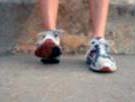
It is a well-known fact that the dorsi- and plantar flexion action of the foot, is a characteristic of sprinters. To improve on the working capacity of the tibialis anterior, extensor digitorum longus, peroneus longus, soleus and gastrocnemius that does most of this work they have to be strengthened and have a greater capacity to apply force faster.
The dorsi flexion action is not merely a lift of the toes, but rather a lifting of the front part of the foot. The plantar flexion action is not just a downward movement of the foot, it has to be done in such a manner that it applies maximum force against the ground in the shortest possible time.
Basically we are trying to to reduce the athletes ground contact time and thus help improve on speed.
Ways To Improve Your Speed:
1. Seated foot up
3 - 4 sets of 30 lifts per foot at varied pace.
2. Standing foot lifts
3 - 4 sets of 30 lifts per foot. As balance plays role here, it can also help improve your stability.
3. Walking with foot lifts. (Small steps)
Everytime you lift your foot up moving forward, make sure you lift your foot up and land on the front part of your foot. Throughout this exercise you stay on your toes. Walk distances of 15 - 20m. 3 - 4 reps.
4. Jogging with foot lifts. (Small steps to long steps)
Do this with stiff knees and "pulling" with the hamstrings and calf muscles to move forward. Dorsi flex the foot everytime it lifts of the ground to take another step. Do 3 - 4 reps over distances ranging from 15 - 35m.
5. Skipping.
This is a very common training method that will enhance the dorsi- and platar flexion. Important to not that the foot lifts up every tiem it leaves the ground. Start with 30 touch downs (Td) and work it up to 100. It can also be done against time.
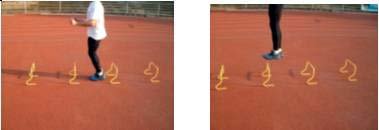
6. Short jumps (Static or dynamic forward movement, mini hurdles)
Do 3 - 4 sets of 1020 jumps and lift the feet after every touchdown. Dynamic jumps - work from 15 - 35m with the same action. IMPORTANT: Try not to bend the knees too much as this will only slow the action down.
The above exercises are just a few thoughts. There are many other coaches with great ideas. It is however important for sprinters to do this type of training at least twice per week in the general preparation phase and once per week during the specific preparation phase.

Body building for tennis
I've designed four separate routines that work different parts of the body. Each workout will help to increase strength, size and stamina and with in turn improve your tennis ability while helping put on mass. For each workout I have included a brief description of while training that part of the body helps to improve your performance on the tennis court.ExercisesA tennis player needs to become stronger, faster, and more agile, and to improve endurance. When I was designing this programme I studied the movements that occurred on the tennis court and selected conditioning exercises that simulated those activities. I also selected exercises that would prevent injuries by correcting muscle imbalances, particularly in the shoulder area. For this part I got a bit of help from the fitness trainer at my club and my tennis coach as I found it difficult to find pacific exercises for this purpose. This programme developed involves an amazing number of muscle groups, each of which makes a specific contribution to performance of the required skills. When I found out all the exercises which would be beneficial I knew I could not do the whole programme in one workout as I would be overtraining my partner, so I would have to do them on separate days which is why I decided on a four day split so my workouts would take around 45 minutes to 1 hour to complete.In tennis you know the first thing you have to do is get to the ball. Most of the exercises in the first workout develop the quick foot speed you need to get to every ball. By reducing foot contact time, you'll cover the court more quickly and efficiently.Workout 1- Foot Speed Depth jump with lateral movement Push-up with clap Hexagon drill Single leg push-off Side-to-side box shuffle Jump and reach Split squat jump Jump over barrier (side) 30-60-90 box drill Jump to box Lateral cone hopsWorkout 2- Lower Body (Legs)Tennis power starts at ground level and works its way up through your body. By the time you make contact with the ball, you've generated a lot of force along this chain. For this reason you need to develop strength in your lower extremities-your legs-so your push-off will be strong. From your serve to your low volleys to even the first step after a wide ball, your game relies on power in your legs. It has been found that Tim Henman has got his personal trainer to help him with his leg development for overall power. This shows how important the leg development is. The following exercises will strengthen these-
Back squat Calf raise (seated) Bench step-up Leg curl (facedown) Calf raise (machine) Leg press Cross-over lunge Side lunge Front lunge Walking lunge 45-Degree lunge
Workout 3- Trunk and AbsYou need a quick start on court, and these exercises will help develop one. They work to support the low back, helping in injury prevention. They also play an important role in maintaining range of motion and strength for serves and overheads. When I serve I bend my back quite far back which has caused me to work on my trunk development. The programme I used and found very effective included- Back extension Hip rotation Bicycle Knee pull-in Glute-ham raise Russian twist Hip press-up Side sit-up Hip roll Sit-up with legs raisedAbdominal MusclesCompleted Everything you do in tennis revolves around your abdominal muscles. Strengthening your abdominals, trunk, and upper extremities will improve your range of motion. These exercises include- Drop pass Pullover toss Kneeling side throwWorkout 4- Upper ExtremitiesYou can't play tennis if you can't hold on to your racket. As your opponents increase the power of their shots, you need to strengthen your grip to fight back. Wrist exercises will not only build strength, they'll also condition the muscles of the forearm to absorb the impact from ball contact. This will decrease your chances of injuries from overuse, such as tennis elbow. During a long match as with other body parts your wrists can hurt the most. This is due to the constant hitting of the ball and the impact that causes your wrists to take a lot of strain. This is why exercising your wrists are very important. The exercises include- Wrist flexion/extension Wrist ulnar/radial flexion Wrist pronation/supinationAll the twisting and turning you do in the course of a day on court puts your body through a rigorous workout. Shoulder exercises will help with your ground strokes and overheads while also preventing injuries. These exercises include-
Pec dec Seated row Prone fly Push press Dumbbell row Pullover and press Bench press Pullover Incline press (barbell) Front and back pulldown
There are four separate workouts in this programme. Each workout should last about 45 minutes- 1 hour and each workout should be done once a week. I have mentioned the different exercises you can do for each workout but did not specify which ones which enables you to change various exercises.
I recommend changing certain exercises every six to eight weeks to prevent your body from getting used to the set exercises. You should go with a 12-15 rep scheme as this will also help with your stamina when you are playing long matches.
I recommend doing three-four exercises and 3 sets per exercise. Remember like with all training concentrate on form rather than letting your ego get the best of you.
Subscribe to:
Comments (Atom)